Complete Beginner's Guide to Valorant
New to Valorant? This comprehensive guide will help you understand the basics and start climbing the ranks.
Complete Beginner's Guide to Valorant
Valorant is Riot Games' 5v5 tactical shooter where gunplay meets character abilities. If you're coming from a different genre — or from no shooter background at all — the learning curve can feel steep. This guide breaks down everything a new player actually needs: how the game works, which agent to pick first, how ranks work, and the habits that separate Iron lobbies from Gold ones.
What Is Valorant?
Valorant pits two teams of five against each other. One side attacks, one defends. Attackers try to plant a bomb-like device called the Spike at one of the map's sites; defenders try to stop them or defuse it. Win 13 rounds first (matches go to overtime past 12-12) and you win the match.
What makes Valorant different from a pure tactical shooter like CS2 is that every character — called an Agent — has unique abilities on top of standard gunplay. That means aim matters, but so does timing your utility and understanding what your kit (and the enemy's) can do.
Getting Started
- It's free-to-play on PC via the Riot Games launcher.
- Account Level 20 is required to unlock ranked (Competitive) play — you'll get there naturally by playing Unrated, Spike Rush, Swiftplay, or Deathmatch.
- Your first 5–10 hours should focus on the in-game Practice Range and Unrated matches, not ranked. Learn recoil control and basic map layouts before queuing competitively.
Core Gameplay Basics
A few mechanics every new player needs to internalize:
Rounds and economy. Every round, you earn credits based on the outcome of the previous round and whether you planted/defused the Spike. You spend those credits on weapons, armor, and abilities at the start of each round. Buying a rifle every single round regardless of your bank balance is one of the fastest ways to lose — economy management is half the game.
One life per round. Like most tactical shooters, there's no respawning mid-round. Get killed, and you're spectating until the round ends. This is why aggressive, careless peeking gets punished hard.
Abilities cost credits too (except your ultimate, which charges over time or via orbs). Don't hoard them — unused utility at the end of a round is wasted value.
Agents and Roles: Picking Your First Main
As of 2026, Valorant has 29 playable agents split across four roles: 8 Duelists, 7 Initiators, 7 Controllers, and 7 Sentinels.
- Duelists — Built to create space and get first kills. High risk, high reward. (e.g., Jett, Phoenix, Reyna)
- Initiators — Gather information and disrupt the enemy before your team pushes. (e.g., Sova, Skye, Gekko)
- Controllers — Block sightlines with smokes and walls to control the map. (e.g., Brimstone, Omen, Astra)
- Sentinels — Hold down areas, watch flanks, and provide utility for the team. (e.g., Sage, Killjoy, Cypher)
For beginners specifically, prioritize agents with simple, low-execution kits over flashy, mechanically demanding ones:
- Sage (Sentinel) - Heals, revives, and can wall off chokepoints. Forgiving and always useful.
- Phoenix (Duelist) - Self-healing and straightforward abilities make him beginner-friendly.
- Brimstone (Controller) - Simple, reliable smokes with no movement-based execution required.
- Sova (Initiator) - Steeper learning curve on aim, but his recon bow rewards map knowledge early.
Avoid agents like Chamber, Raze, or Yoru as a first pick - they're powerful but punish mistakes severely or require precise movement tech.
A quick note on the meta: agent win rates shift with every patch, so don't chase "tier list" picks as a beginner. Pick one agent per role, learn their full kit, and build comfort before expanding your pool.
Maps: What to Expect
Valorant rotates a pool of maps in and out of Competitive play roughly every Act (Riot keeps about 7 maps active at a time so the pool doesn't get overwhelming). Classics you'll see across most rotations include Ascent, Bind, Haven, Split, and Icebox, with newer additions cycling in over time.
Don't try to memorize every callout on day one. Instead:
- Learn the bomb sites and main chokepoints first.
- Learn one or two common smoke/wall lineups for your main agent per map.
- Pick up callouts naturally by playing — you don't need a spreadsheet.
Understanding the Rank System
Valorant's competitive ladder has 9 tiers, from lowest to highest:
Iron → Bronze → Silver → Gold → Platinum → Diamond → Ascendant → Immortal → Radiant
Every tier except Radiant has 3 divisions (e.g., Gold 1, Gold 2, Gold 3), giving 25 total rungs. You climb by earning Rank Rating (RR) — generally 10–35 RR per win depending on performance — and need 100 RR to promote a division. Radiant is reserved for the top ~500 players per region and works differently from the standard RR ladder.
There's no rank decay, so taking a break won't drop your rank. Most players land somewhere in Silver to Gold, which is the largest population band — don't panic if that's where you start.
Essential Tips for Beginners
- Crosshair placement over flick aim. Keep your crosshair at head height, pre-aimed at common angles. This matters more than raw mouse sensitivity.
- Don't peek alone without info. Use utility, teammates, or sound cues before pushing into the unknown.
- Manage your economy. Know when to "save" (skip buying) instead of force-buying every round.
- Communicate concisely. Callouts like "one pushing B short, low HP" are more useful than silence or panic-shouting.
- Use the Practice Range daily. Five minutes of recoil and flick practice before you queue pays off over a session.
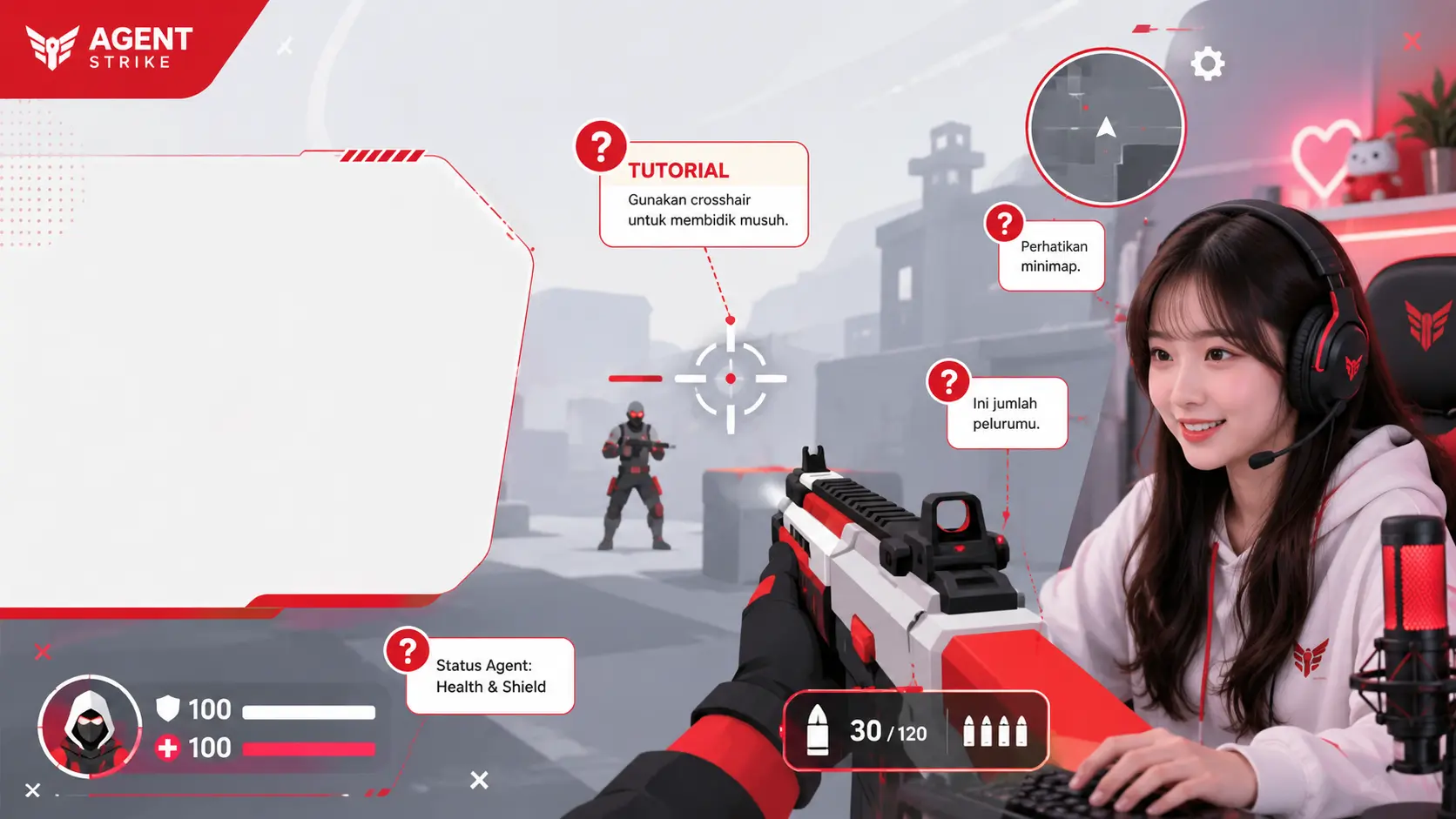
- Watch the minimap. It tells you spike status, teammate positions, and ability cooldown info.
Common Mistakes New Players Make
- Holding too many angles alone instead of trading with teammates.
- Forgetting to communicate ultimate or ability cooldowns.
- Over-rotating based on a single piece of information.
- Buying skins before understanding the game - fun, but not a priority for round one.
- Tilting after a loss instead of resetting mentally between rounds.
FAQ
Is Valorant hard for beginners? It has a learning curve due to ability-based gameplay layered on top of gunplay, but the lower ranks are genuinely beginner-friendly, and Riot's matchmaking groups new players together early on.
What's the best agent to start with? Sage, Phoenix, or Brimstone are commonly recommended first agents because their kits are simple and effective without requiring precise execution.
Do I need good aim to play Valorant? Aim helps, but positioning, utility usage, and game sense matter just as much — especially at lower ranks where most rounds are decided by mistakes, not aim duels.
How long until I can play ranked? You need Account Level 20, which most players reach within their first several hours of casual play.
Does Valorant rank decay if I stop playing? No. Your rank stays the same after inactivity, though Immortal and Radiant players need to play roughly once every 7 days to keep their leaderboard spot.
Final Thoughts
Valorant rewards patience more than raw talent in the early hours. Pick one agent, learn a couple of maps properly, manage your economy, and focus on crosshair placement before anything else. The rest - callouts, lineups, advanced meta - comes naturally with reps.