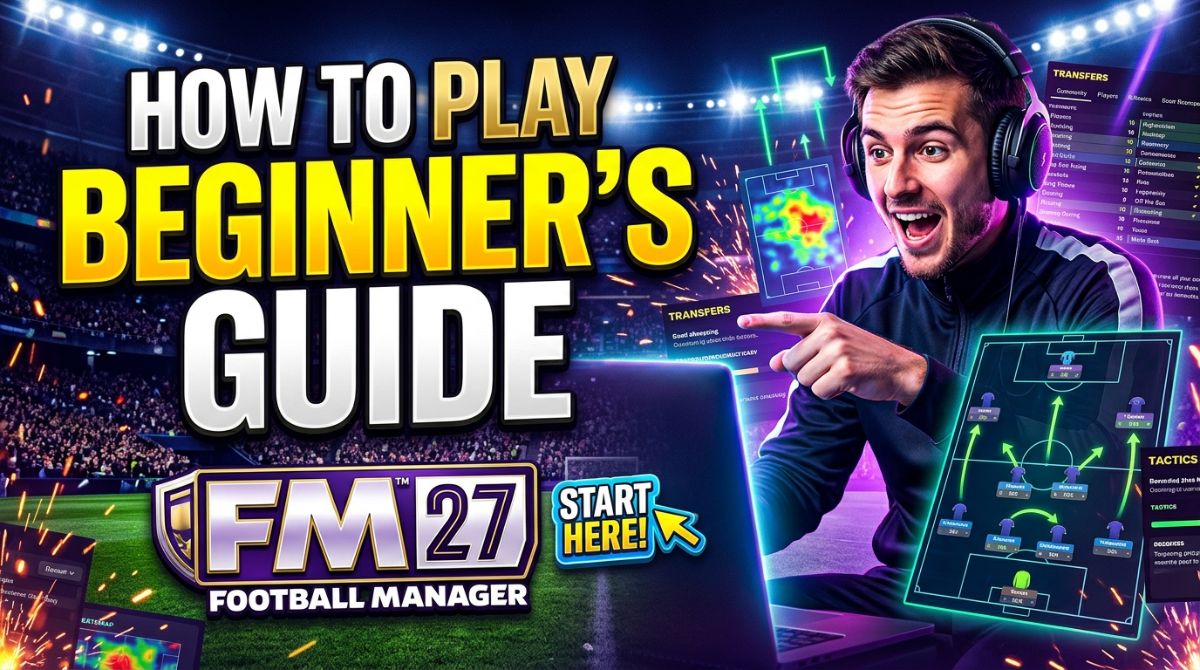
How to Play Football Manager: Beginner's Guide (FM27)
New to Football Manager? Learn how to set up your first save, pick a club, build a simple 4-2-3-1 tactic, run training, make smart transfers and win matches in FM27.
Published: November 19, 2026 · Updated: November 19, 2026
To play Football Manager, you pick a club, set a tactic, manage training and transfers, then let the match engine simulate games based on your decisions. You never control players on the pitch. Every result comes from how well you prepare the squad, which is why the game feels so rewarding once it clicks.
This guide walks new players through their first save step by step: choosing a club, the best starter settings, building a simple tactic, handling training, morale and transfers, and getting through match days. It is written for Football Manager 27, which launched on November 10, 2026, but the fundamentals apply to every recent edition.
What Is Football Manager?
Football Manager (FM) is a football management simulation developed by Sports Interactive and published by SEGA. You take the role of a club manager and make the decisions a real manager makes: picking the team, setting tactics, signing players, managing the budget and keeping the board and fans happy.
A match engine simulates every game using the attributes of thousands of real players and staff. Your tactics, team selection and in-game changes shape what happens on the pitch.
Which version should you play?
The newest edition is Football Manager 27, released on November 10, 2026. Sports Interactive shipped the first major patch, Update 27.1.0, on November 17, 2026, on Steam, the Epic Games Store and the Microsoft Store (Steam). Before launch, the FM27 Launch Preview was free to play on PC and Mac until November 3, 2026 (Football Manager).
If you already own FM26 or FM24, everything in this guide still applies. The core systems (tactics, training, recruitment and match days) work the same way across recent editions.
How does a typical game week work?
Most of your time follows a four-step loop. Once you understand it, the menus stop feeling overwhelming.
- Prepare: check injuries and fitness, set training, read the opposition report.
- Play: pick the team, give a team talk, watch the match and make changes.
- Review: read the match analysis and staff feedback, then adjust the tactic if needed.
- Build: scout players, negotiate transfers and develop young players over the season.
How to Set Up Your First Football Manager Save
Start at the beginning of pre-season with a mid-table club in a league you know. That gives you a full transfer window, friendlies to test tactics and realistic board expectations while you learn.
Which club should a beginner choose?
Pick a club that forgives mistakes. Giant clubs expect trophies immediately, and tiny clubs have no money to fix problems. Look for:
- A mid-table target rather than "win the league" or "avoid relegation".
- A squad that is decent for its division, so you are not rebuilding from scratch.
- Some transfer and wage budget to fill one or two weak positions.
- A league you follow in real life, so player names and rival clubs make sense.
What are the best starter settings?
A few setup choices make the first season much easier. The official Football Manager team, for example, recommends disabling attribute masking on a new save so you can see player stats without scouting them first (Football Manager, The Dugout).
| Setting | Recommendation | Why it helps |
|---|---|---|
| Start date | Beginning of pre-season | Full transfer window and friendlies to learn the game |
| Leagues loaded | 2–4 nations | Enough players to scout, faster game processing |
| Attribute masking | Off | See player attributes without scouting first |
| Past playing experience | The highest option available | Players and staff respect you sooner |
| First transfer window | Optional: disable it | Keeps real-life squads intact at the start |
| Fixtures | Real fixtures | Easy to compare your season with reality |
How do you find your way around the menus?
Use the in-game search bar instead of memorising where every screen lives. Bookmark the screens you check daily, such as Squad, Tactics, Training and Transfers. You cannot break anything by clicking around, so explore freely in your first few in-game weeks (FM Scout).
How to Build Your First Football Manager Tactic
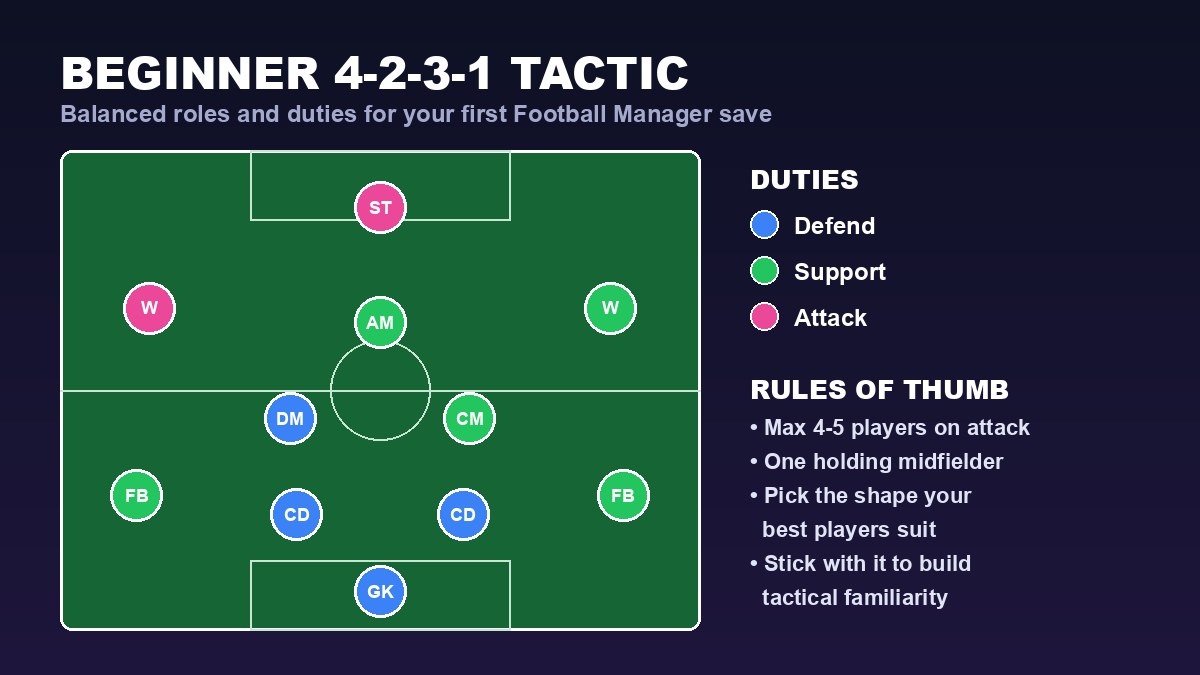
Load a built-in tactical preset, choose a formation that suits your best players and keep a sensible balance of attacking and defensive duties. A simple, balanced tactic beats an over-complicated one in almost every beginner save.
Should you use a tactical preset?
Yes. Football Manager includes presets built around familiar styles such as gegenpress, tiki-taka and counter-attack. They are designed to work out of the box, and they let you see what each team instruction does before you start tweaking it.
Which formation is best for beginners?
Choose a shape that fits the players you already have. Look at where your best three or four players play, whether you have natural wingers and whether your strikers work better alone or in pairs.
| Formation | Strengths | Best for |
|---|---|---|
| 4-2-3-1 | Balanced, flexible, forgiving | Most squads and first saves |
| 4-3-3 | Width and pressing high up the pitch | Teams with quick, skilful wingers |
| 4-4-2 | Simple, compact, two strikers | Lower-league squads and direct football |
What are roles and duties?
A role tells a player what to do, and a duty (defend, support or attack) tells them how aggressively to do it. Keep the balance sensible: if both full-backs and both central midfielders are on attack, your defence will be exposed. A useful rule of thumb is no more than four or five players on an attacking duty.
Why does tactical familiarity matter?
Players need time to learn a new system, and an unfamiliar tactic performs worse. Familiarity builds through training and matches, so choose your main tactic early in pre-season and stick with it rather than switching after every bad result.
How to Manage Training, Morale and Transfers
Delegate training if you are unsure, keep key players happy with regular minutes, and limit transfers to the one or two positions that need it most. Football Manager is won between matches as much as during them.
How should you set up training?
You can control every session or hand training to your assistant manager, and delegating is perfectly fine for a first save. If you manage it yourself:
- Focus pre-season on fitness and tactical familiarity.
- During the season, balance match preparation with recovery sessions.
- Use individual training to develop young players in a specific role.
How do you keep morale high?
Morale directly affects how players perform. Give key players regular minutes, praise good form, handle poor form privately and keep any promises you make in player conversations. In team talks, a calm and encouraging tone works more often than shouting.
How should beginners handle transfers?
Fix weak spots instead of rebuilding the whole squad. A simple process:
- Identify one or two weak positions using player ratings and staff reports.
- Set recruitment focuses so your scouts look for exactly the profile you need.
- Target free agents and players with expiring contracts for good value.
- Check wages, not just transfer fees. An inflated wage bill limits you for years.
- Sell or loan out players who will not play to free up budget and squad places.
Loans are underrated. Borrowing a talented young player from a bigger club can fill a gap for very little money.
Why are your staff important?
Your backroom staff do much of the analysis for you. Hire a capable assistant manager, good coaches and scouts with strong judging ability. Their reports flag injuries, unhappy players, tactical weaknesses and promising transfer targets, so read them regularly.
How to Win Matches in Football Manager
Prepare with the opposition report, pick a fit and in-form team, watch highlights and make one or two targeted changes when something is not working. Small, well-timed adjustments win more games than drastic ones.
What should you do before kick-off?
- Read the opposition report to see their formation and dangerous players.
- Pick your lineup based on form, condition and match sharpness.
- Give a pre-match team talk that fits the occasion, such as calm against weaker sides and motivating in big games.
What should you watch during the match?
You do not need to watch all 90 minutes. Extended or key highlights show the important moments. Keep an eye on player ratings and condition, listen to your assistant's feedback, and adjust your mentality to the scoreline: more cautious to protect a lead, more attacking when chasing a goal.
How do you use half-time and post-match analysis?
Make one or two specific changes at half-time rather than five. After the final whistle, check expected goals (xG), shots and possession. These numbers show whether the result was deserved or lucky, which tells you whether the tactic really needs changing.
What Mistakes Should Beginners Avoid?
Most failed first saves come from the same few errors. Avoid these and you will last much longer in your first job:
- Changing tactics after every loss. Give the system time to become familiar.
- Overspending on wages. It removes flexibility for future seasons.
- Ignoring board expectations. Miss them badly and you will be sacked.
- Signing too many players. An overcrowded squad hurts morale.
- Neglecting the youth academy. Young players can become stars for free.
- Panicking during a bad run. Every club has one. Check the underlying stats first.
Frequently Asked Questions
Is Football Manager hard for beginners?
Football Manager has a learning curve, but it is manageable. Use tactical presets, delegate training to your staff and choose a mid-table club with modest expectations. Most new players feel comfortable within their first in-game season.
What is the best club to start with in Football Manager?
A mid-table club in a league you know is ideal. You want a decent squad, some budget and realistic board expectations so you have time to learn without being sacked early.
What is the easiest formation in Football Manager?
The 4-2-3-1 is widely seen as the most beginner-friendly formation. It balances defence and attack, suits most squads and works well with the built-in tactical presets.
Do you need to watch full matches in Football Manager?
No. Extended or key highlights are enough for most players. They show the important moments and let you react tactically without watching every minute.
When was Football Manager 27 released?
Football Manager 27 launched on November 10, 2026. The first major patch, Update 27.1.0, followed on November 17, 2026, on Steam, the Epic Games Store and the Microsoft Store.
Final Thoughts
Football Manager rewards patience more than anything else. Start with the right club and settings, pick a simple tactic that suits your squad, keep morale high, make a few smart signings and learn from every match. Once you stop trying to master every screen at once, the game opens up quickly.
Sources:Football Manager 27 on Steam, Football Manager: First 10 things to do, Football Manager 27 free to play until 3 November, FM Scout beginner's guide.