AI Checker Free: How Free AI Detectors Actually Decide Your Text Is Machine-Written
Free AI checkers return a percentage, not a verdict. This guide breaks down the three signals they measure (perplexity, burstiness, and trained classifiers), why they misfire on non-native and heavily edited writing, and how to read a score without drawing the wrong conclusion.
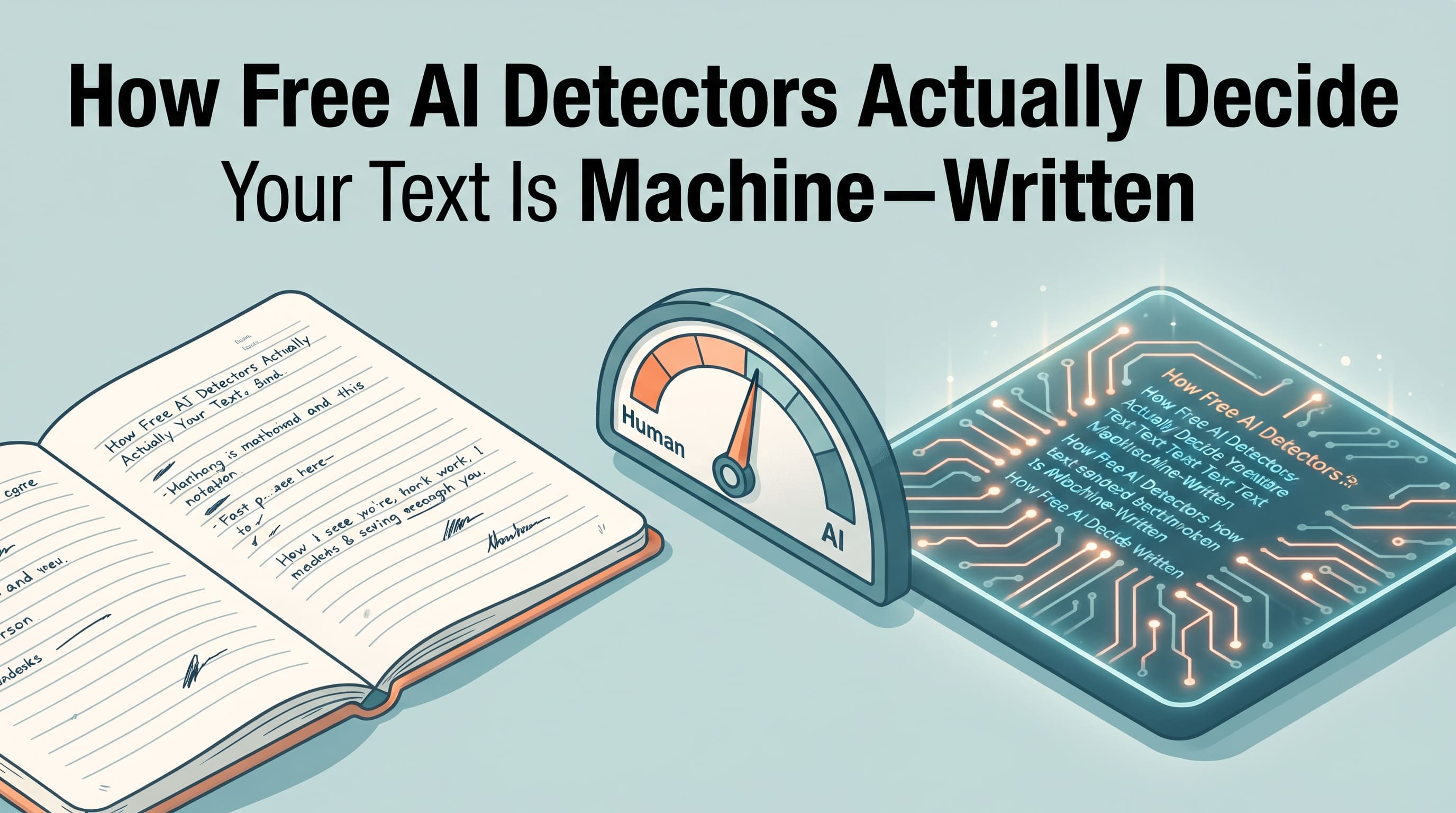
AI Checker Free: How These Tools Actually Decide Your Text Is Machine-Written
Search "AI checker free" and you get a wall of tools promising 99% accuracy in three seconds. Almost none of them explain what they are measuring. That gap matters, because the number a free detector hands you is not a verdict. It is a probability estimate produced by a statistical model that has never seen your writing before and does not know who you are.
Here is what is happening under the hood.
An AI detector is a classifier, not a witness
A detector does not read your essay and recognize ChatGPT's handwriting. It runs your text against patterns it learned from labeled training data and returns a score. The output is closer to a weather forecast than a fingerprint match.
That framing explains most of the confusion around these tools. A 78% AI score does not mean 78% of your document came from a model. Depending on the tool, it can mean the classifier's confidence, an average across sentence-level scores, or a proportion of flagged passages. Free tools rarely tell you which.
The three signals almost every free AI checker uses
Perplexity
Perplexity measures how predictable your word choices are to a reference language model. Feed it a sentence, and it asks: given everything before this word, how surprised am I by this word?
Language models generate text by picking high-probability tokens, so their output tends to score low on perplexity. Human writing is messier. We reach for the odd word, abandon a clause halfway, and use phrasing nobody would have predicted. Low perplexity across a whole document pushes the score toward "AI."
Burstiness
Burstiness looks at the same idea one level up, across sentences instead of words. Real writing has uneven rhythm. A long sentence with several clauses, then a short one. Sometimes a fragment.
Older models produced flatter output, with sentences of similar length and similar complexity all the way through. Burstiness scoring is built to catch that evenness.
Trained classifiers
Perplexity and burstiness were the whole story around 2022 and 2023. They are not anymore. Current detectors feed those scores, plus other features, into a neural classifier trained on large sets of labeled human and machine text. Originality.ai uses a fine-tuned transformer. Turnitin runs its own proprietary model. What the classifier learns is a statistical fingerprint: certain transitions, certain sentence shapes, certain formatting habits that correlate with model output.
Some tools layer on extra checks, including token-level probability mapping and pattern detection for repeated sentence openers or heavy bullet-list formatting.
Why free AI checkers get things wrong
Every signal above degrades as models improve. Newer models produce text with higher perplexity and more sentence variation than their predecessors did, which erodes the gap the detectors were built to find.
Two failure modes matter most in practice.
False positives on human writing. A Stanford study tested several detectors on TOEFL essays written by non-native English speakers and found the majority were flagged as AI-generated. Non-native writers often use simpler vocabulary and steadier sentence structure, which is exactly the pattern a detector reads as machine-like. Careful, heavily edited academic prose can trip the same wire.
Missed detections on edited text. Detection rates drop sharply once AI output has been paraphrased or revised by a person. Reported figures vary a lot between tests, but the direction is consistent across all of them: light editing defeats most free detectors.
There is also a gap between vendor benchmarks and real use. Vendors test on clean samples, meaning obviously human text against raw model output. Actual documents sit somewhere in between, because people draft with AI, edit with AI, and write alongside it.
Reading a free AI checker score without embarrassing yourself
A few rules that hold regardless of which tool you use.
Run the text through more than one detector. Scores diverge wildly between tools on the same input, and that divergence is itself information.
Check what the free tier actually gives you. Caps differ a lot and change often. Some tools limit characters per scan, some limit words per month, some require an account before the useful features unlock. Verify the current limit on the tool's own page rather than trusting a comparison article, including this one.
Treat sentence-level highlighting as more useful than a single percentage. Knowing which passages triggered the flag tells you something you can act on.
Never treat a score as evidence of misconduct. Not in a classroom, not in a hiring decision, not in a client dispute. Drafts, version history, and a conversation with the writer are worth more than any detector output.
Where detection is heading
The statistical approach has a ceiling, and the field knows it. Two other paths are being built out.
Watermarking embeds a signal at generation time. Google DeepMind's SynthID is the visible example. Instead of guessing from the finished text, the watermark is planted by the model that produced it. The obvious limit is coverage: it only works where the generating system supports it.
Provenance standards like C2PA attach content credentials to a file, recording how it was made and edited. Same limitation applies. It depends on the tools in the chain cooperating.
Neither replaces detection today. Both point at the same conclusion, which is that verifying authorship from the text alone is a losing game as models get better.
The short version
Free AI checkers measure predictability and rhythm, then run those measurements through a trained classifier. They were built against a gap between human and machine writing that is closing. They are useful for a quick screen on unedited text and for spotting passages worth a second read. They are not proof of anything, and using them as proof is how people get wrongly accused.
If you are checking your own work, the score is a prompt to reread the flagged sections. If you are checking someone else's, the score is the beginning of a conversation, not the end of one.
Tags